ChatGPT vs Claude vs Gemini: a work-focused comparison for 2026.
Three AI assistants now dominate the modern workplace: OpenAI’s ChatGPT, Anthropic’s Claude and Google’s Gemini. Each one can draft an email, summarize a 60-page report, write a spreadsheet formula and debug code. Each costs roughly $20 a month for a standard paid plan. So how do you choose?
The honest answer is that the best AI assistant for work depends on what your work looks like. This guide compares ChatGPT, Claude and Gemini across the things that matter on a normal Tuesday: writing, coding, research, integrations, privacy, team features and price. At the end you’ll find a simple decision guide and answers to common questions.
Quick verdict
- Choose Claude if you write, edit, code or analyze long documents for a living.
- Choose Gemini if your team runs on Google Workspace, or you need strong image and video generation plus bundled storage.
- Choose ChatGPT if you want the broadest all-in-one toolbox: voice, image generation, agents, connectors and the largest plugin ecosystem.
ChatGPT vs Claude vs Gemini at a glance
| ChatGPT | Claude | Gemini | |
|---|---|---|---|
| Made by | OpenAI | Anthropic | |
| Current model family | GPT-5.6 (Sol, Terra, Luna) | Claude 5.5 family (Opus, Sonnet, Haiku) | Gemini 3 family (3.1 Pro as of mid-2026) |
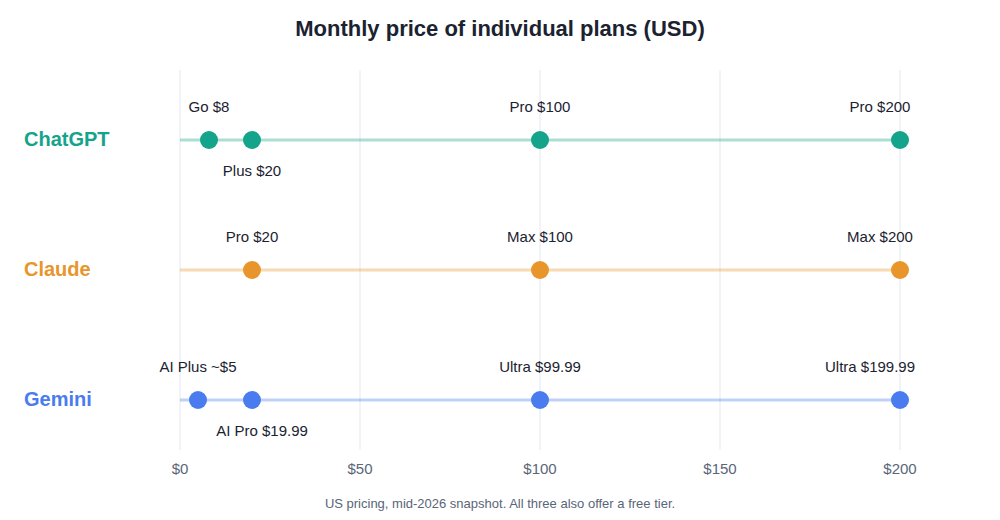
| Entry paid plan | Go, about $8/mo | Pro, $20/mo ($17/mo billed annually) | Google AI Plus, about $5/mo (varies by region) |
| Standard plan | Plus, $20/mo | Pro, $20/mo | Google AI Pro, $19.99/mo |
| Power-user plans | Pro, $100 or $200/mo | Max, $100 or $200/mo | AI Ultra, $99.99 or $199.99/mo |
| Team plan | Business, $20-$25 per user/mo | Team and Enterprise plans | Gemini inside Google Workspace plans |
| Standout strength | Widest feature set | Writing quality, coding, long documents | Google integration, multimedia, storage bundle |
Prices are US snapshots from mid-2026 and change often. Confirm on each vendor’s pricing page before buying.
Pricing: nearly identical at the standard tier
At the plan most professionals buy, the three are almost interchangeable on price: ChatGPT Plus is $20 a month, Claude Pro is $20 ($17 a month if billed annually) and Google AI Pro is $19.99. Differences show up at the edges.Monthly price of individual plans (USD)$0$50$100$150$200ChatGPTClaudeGeminiGo $8Plus $20Pro $100Pro $200Pro $20Max $100Max $200AI Plus ~$5AI Pro $19.99Ultra $99.99Ultra $199.99US pricing, mid-2026 snapshot. All three also offer a free tier.Individual plan pricing for ChatGPT, Claude and Gemini (US, mid-2026).
A few pricing details worth knowing:
- ChatGPT has the most tiers. Its cheap Go plan is supported by ads, and OpenAI has started showing ads on lower tiers in some countries. Its Business plan adds SOC 2 compliance, single sign-on and an admin console, and excludes conversations from model training by default.
- Claude keeps its lineup simple: Free, Pro and two Max tiers. Claude Code, the terminal-based coding agent, is included with Pro and Max. Anthropic states that Claude products are ad-free.
- Gemini bundles Google One storage with its Google AI plans, which makes AI Pro strong value if you’d pay for storage anyway. Google also cut the top Ultra tier price in 2026, so check current numbers.
Best AI for writing and editing
For everyday work writing (emails, reports, proposals, documentation), all three produce competent drafts. The difference is in voice. Claude is widely praised for prose that reads naturally, follows a requested tone closely and needs less cleanup. ChatGPT is versatile and quick to adapt to formats, from social posts to slide outlines, but its default style can feel more templated. Gemini is solid, and gets better when it can draw on your own Docs and Gmail context.
Edge: Claude for polished long-form writing; ChatGPT for variety and speed; Gemini when the source material already lives in Google apps.
Best AI for coding
Developers are the most vocal about this comparison. Claude has built a strong reputation for software work, helped by Claude Code, an agent that reads your codebase, runs commands and carries out multi-step changes. ChatGPT counters with Codex and agent features inside the main app. Gemini offers Jules, an asynchronous coding agent, plus tight links to Google Cloud, and tends to be cheaper per token for API users.
Edge: Claude for deep refactors and debugging; ChatGPT for breadth and tooling; Gemini for Google Cloud-centered stacks and low API cost.
Best AI for research and long documents
All three now offer a deep research mode that browses the web and returns a cited report. For long files, context window size matters: top models from Anthropic and Google both support context windows of up to around 1 million tokens, enough for several books’ worth of text. In practice, plan limits kick in before the ceiling does, so test with your real documents.
Gemini adds NotebookLM, a research workspace that turns your uploaded sources into summaries, audio overviews and Q&A. Claude is often favored for careful analysis of dense material such as contracts and technical papers. ChatGPT’s strength is flexibility across file types and connectors.
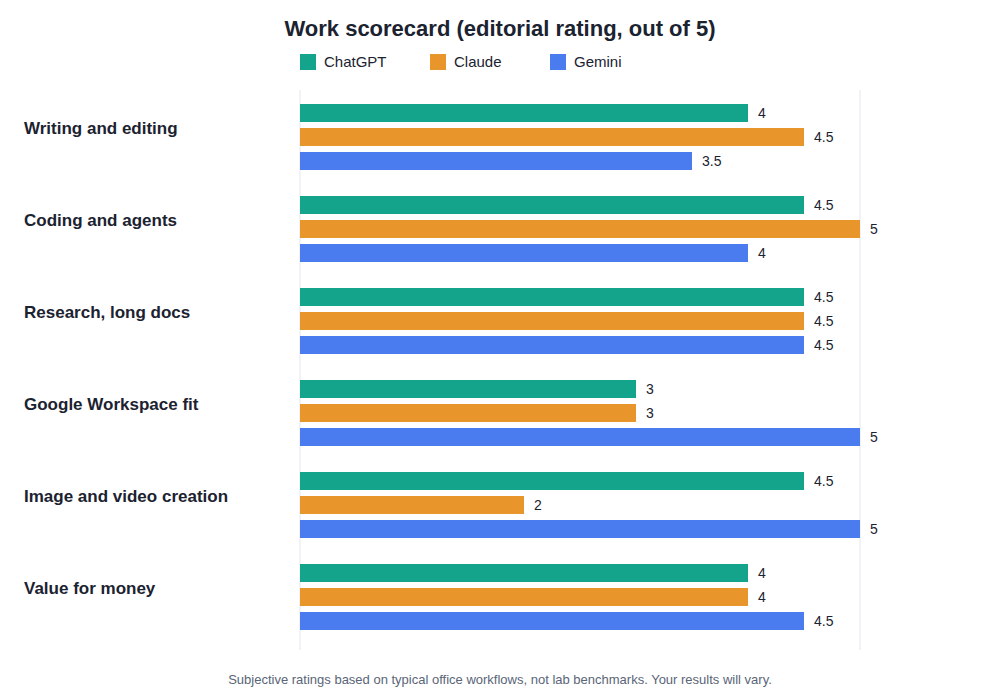
Edge: A three-way tie, with Gemini ahead for source-based research workflows and Claude ahead for careful reading.Work scorecard (editorial rating, out of 5)ChatGPTClaudeGeminiWriting and editingCoding and agentsResearch, long docsGoogle Workspace fitImage and video creationValue for money44.53.54.5544.54.54.53354.525444.5Subjective ratings based on typical office workflows, not lab benchmarks. Your results will vary.Editorial scorecard: where ChatGPT, Claude and Gemini each lead for work tasks.
Integrations and ecosystem
ChatGPT
ChatGPT has the broadest consumer toolbox: voice conversations, image generation, Deep Research, Codex for coding, Sora for video, and agent features such as ChatGPT Work for longer multi-step jobs. Business plans add dozens of connectors, including Slack and Google Drive.
Claude
Claude focuses on depth rather than breadth. Projects keep documents and instructions together, Artifacts let you build small apps and documents in the chat window, and links to Google Workspace and other tools bring in your data. For desktop work there is Claude Cowork for knowledge-work tasks, plus Claude in Chrome, Excel and PowerPoint for working inside those apps.
Gemini
Gemini’s advantage is that it lives where many people already work: Gmail, Docs, Sheets, Drive, Meet and Android. If your company uses Google Workspace, Gemini can summarize a thread, draft a reply and pull from a shared doc without copy-pasting anything.
Image, video and multimodal work
This is where the field is most uneven. Gemini and ChatGPT both generate images, and both have video tools (Veo for Google, Sora for OpenAI). Claude can read images, PDFs and charts and can produce diagrams and SVG graphics, but it does not generate photorealistic images or video. If marketing visuals are a big part of your job, lean toward Gemini or ChatGPT.
Privacy, security and team features
For client work and regulated industries, read the data policies on whichever plan you buy. Business and enterprise tiers across all three vendors generally offer admin controls, single sign-on and options that keep your conversations out of model training. Consumer plans differ, so check the settings. Google’s strength is that many companies already have a Workspace agreement in place. ChatGPT Business is mature and well documented. Claude’s Team and Enterprise plans emphasize safety controls and are popular with developer-heavy organizations.
Which AI assistant should you choose?
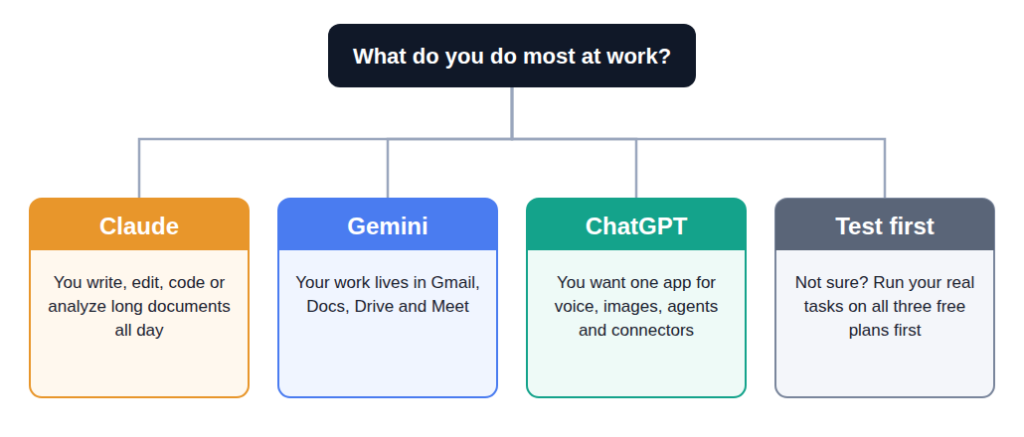
What do you do most at work?ClaudeYou write, edit, code oranalyze long documentsall dayGeminiYour work lives in Gmail,Docs, Drive and MeetChatGPTYou want one app forvoice, images, agentsand connectorsTest firstNot sure? Run your realtasks on all three freeplans firstA simple decision guide for choosing between ChatGPT, Claude and Gemini.
Choose Claude if…
- Writing quality and a natural tone matter more than extra features.
- You code daily and want an agent that can work across a whole project.
- You analyze long contracts, research papers or reports.
- You prefer a simple plan structure with no ads.
Choose Gemini if…
- Your company runs on Google Workspace.
- You want image and video generation in the same subscription.
- You’d benefit from bundled cloud storage, which makes the plan cheaper in practice.
- You’re building on Google Cloud and want low API pricing.
Choose ChatGPT if…
- You want the widest set of built-in tools in a single app.
- You use voice mode, image generation and agents regularly.
- Your team needs a mature business plan with lots of connectors.
- You want a cheaper entry plan and accept ads.
Can you use more than one?
Yes, and many professionals do. A common setup is one paid assistant as your daily driver and a free tier of a second for tasks it handles better. For example: Claude Pro for drafting and code, plus Gemini’s free tier for quick Google Drive questions. Because the three standard plans cost about the same, paying for two is cheaper than most single software subscriptions.
How to run a fair 30-minute test
- Pick three real tasks from this week: a draft you need to write, a document you need to summarize and a spreadsheet or code problem.
- Paste the exact same prompt into all three assistants.
- Score each answer on accuracy, tone and how much editing it needs.
- Check the plan limits: how quickly do you hit the cap on your usual workload?
Benchmarks and online debates change every few months as new models launch. Your own tasks are the best test.
Frequently asked questions
Which is better for work: ChatGPT, Claude or Gemini?
None wins everywhere. Claude leads for writing and coding, Gemini leads for Google Workspace and multimedia, and ChatGPT leads for breadth of features.
Is Claude better than ChatGPT?
For long-form writing, careful analysis and coding, many professionals prefer Claude. ChatGPT is stronger for image generation, voice and its larger ecosystem of tools.
Is Gemini better than ChatGPT?
If you live in Gmail, Docs and Drive, Gemini often feels more useful because it works with your files directly. ChatGPT remains more versatile outside the Google ecosystem.
Which AI assistant is cheapest?
Entry plans start around $5 for Google AI Plus and $8 for ChatGPT Go (with ads). At the standard professional tier, ChatGPT Plus, Claude Pro and Google AI Pro cost about $20 a month each.
Which is best for coding?
Claude, with Claude Code, is a popular choice for serious development. ChatGPT (Codex) and Gemini (Jules) are strong alternatives, and Gemini is cheaper for API-heavy workloads.
Are these tools safe for confidential work data?
Use a business or enterprise plan for confidential material and review each vendor’s data and training policies. Avoid pasting sensitive data into personal free accounts.
Final verdict
There’s no single champion, and that’s good news: all three are excellent, and the right pick follows your workflow. Writers, analysts and developers will likely be happiest with Claude. Teams on Google Workspace and creators who need visuals should look hard at Gemini. People who want one app that does a bit of everything will enjoy ChatGPT. Start with the free tiers, test your own tasks, then pay for the one you keep reaching for.
Disclosure and update note: Models, limits and prices for AI products change frequently. Details here reflect mid-2026 information; verify on each vendor’s official site before purchasing. [Add your own disclosure here if you have affiliate relationships.]