ECOMMERCE GUIDE · 2026 Best Meta Ads Tools for Ecommerce Attribution · Automation · Creative · Catalog Lower CPA Higher ROAS Scale Faster
Best Meta Ads Tools for Ecommerce in 2026 (Tested & Ranked)
Running Facebook and Instagram ads for an online store is no longer about clever targeting. Meta’s AI (Advantage+ and its Andromeda retrieval system) now decides much of who sees your ads, so the levers left to you are data quality, creative volume and smart budget rules. That is exactly where the best Meta ads tools for ecommerce earn their price.
This guide breaks down the tools worth considering, what each one is best at, and how to assemble a stack that fits your spend, without paying for features you won’t use.
Quick answer: Start with Meta Ads Manager plus a clean Pixel and Conversions API setup. Add an attribution tool (Triple Whale, Northbeam or Cometly) once you spend consistently, a creative tool (Motion, Foreplay, AdCreative.ai) to beat ad fatigue, and an automation tool (Revealbot or Madgicx) when manual optimisation eats your week.
What Are Meta Ads Tools?
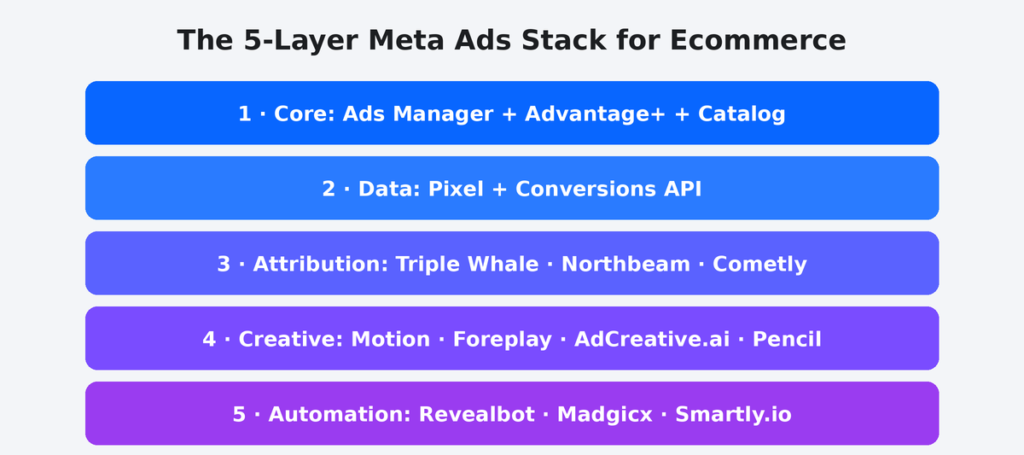
Meta ads tools are third-party platforms that connect to Meta’s Ads API and do what Ads Manager does not: cross-account rule automation, server-side tracking, creative research and analysis, bulk ad launching, reporting and independent attribution. For ecommerce, they fall into five jobs.
How We Evaluated the Tools
Each tool was judged on depth of Meta integration, ecommerce-specific features (catalogs, product feeds, profit tracking), ease of use, reporting accuracy, and how well it suits different monthly ad budgets. Pricing changes often, so check each vendor’s site for current plans.
1. Native Meta Tools (Your Foundation)
Meta Ads Manager & Advantage+ Shopping Campaigns
Best for: every ecommerce advertiser. Ads Manager is free, and Advantage+ sales campaigns use Meta’s AI to find buyers across placements from your catalog. Master these before paying for anything else.
Meta Pixel + Conversions API (CAPI)
Best for: accurate conversion data. The browser Pixel alone misses sales due to ad blockers and privacy changes. Sending events server-side via CAPI (Shopify’s Facebook & Instagram app, WooCommerce plugins, or tools like Conversios and Cometly) gives Meta’s algorithm better fuel.
Meta Ad Library
Best for: free competitor research. Search any brand’s active ads to see which angles and formats they keep running.
2. Attribution & Analytics Tools
Meta’s own ROAS tends to over-credit itself. These tools show what actually drove revenue.
Triple Whale
Best for: Shopify brands wanting a single dashboard for blended ROAS, profit and multi-channel performance. Popular with DTC teams for its ecommerce focus.
Northbeam
Best for: larger brands optimising the entire media mix. It uses machine-learning attribution to compare channels, not just Meta.
Cometly
Best for: stores that want server-side tracking synced back to Meta via CAPI so optimisation runs on more reliable data.
3. Creative Tools (Beat Ad Fatigue)
With targeting largely automated, creative is the biggest performance lever. These tools help you make, test and learn from more ads.
Motion
Best for: creative analytics. See which hooks, formats and visuals drive spend and conversions, and report on them to your team.
Foreplay
Best for: ad inspiration. Save competitor ads from the Meta Ad Library with a browser extension and organise them into swipe files and briefs.
AdCreative.ai
Best for: high-volume static image ads. Generate many variations quickly to test, which suits stores with large catalogs.
Pencil
Best for: generative video ads and predicting which creatives may perform before launch.
Pipiads
Best for: dropshippers and product researchers who search competitor Facebook and TikTok ads by product and engagement.
4. Automation & Optimisation Tools
Revealbot
Best for: rule-based control. Automatically scale winners, pause losers and adjust budgets using conditions you define, across Meta, Google and TikTok.
Madgicx
Best for: an all-in-one Meta cockpit for ecommerce and SMB advertisers, combining AI audiences, creative insights, automation tactics and reporting.
Adstellar
Best for: brands that want AI-assisted campaign creation and optimisation to reduce manual work as spend grows.
Smartly.io
Best for: enterprise teams that need scaled creative production, catalog ads and cross-channel automation (Meta, Pinterest, Snapchat, TikTok).
AdEspresso by Hootsuite
Best for: simple A/B testing and campaign creation for smaller teams.
Comparison Table
| Tool | Category | Best for | Ideal stage |
|---|---|---|---|
| Ads Manager + Advantage+ | Native | Everyone | All |
| Triple Whale | Attribution | Shopify DTC profit tracking | Growth |
| Northbeam | Attribution | Multi-channel media mix | Scale / enterprise |
| Cometly | Tracking / CAPI | Reliable server-side data | Starter to growth |
| Motion | Creative analytics | Learning what creative wins | Growth |
| Foreplay | Inspiration | Swipe files & briefs | All |
| AdCreative.ai | Creative generation | Volume image ads | Starter to growth |
| Revealbot | Automation | Custom rules | Growth |
| Madgicx | All-in-one | AI audiences + automation | Starter to growth |
| Smartly.io | Enterprise | Large catalogs, cross-channel | Enterprise |
Which Tools Should You Choose?
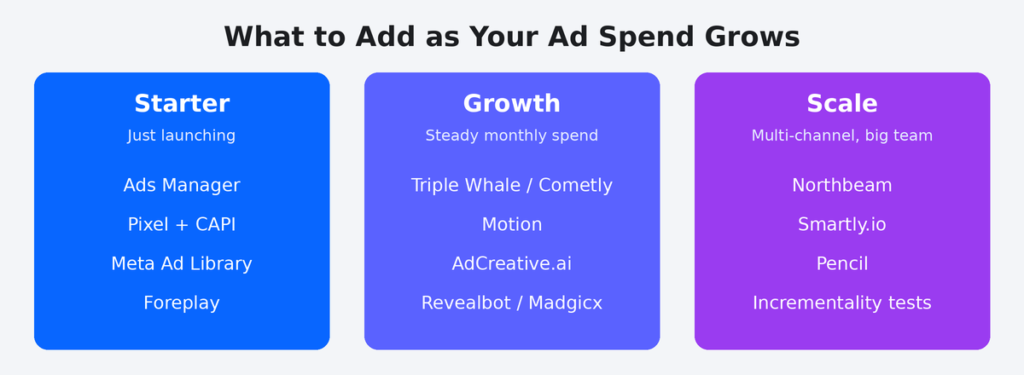
- Just starting out: native tools, a solid CAPI setup and free research. Spend your budget on creative, not software.
- Struggling with tracking: Triple Whale, Northbeam or Cometly.
- Creative fatigue: Motion, Foreplay, AdCreative.ai or Pencil.
- Too much manual work: Revealbot or Madgicx.
- Enterprise or agency scale: Smartly.io plus an attribution platform.
Common Mistakes to Avoid
- Buying tools before fixing tracking. Automation on bad data just scales bad decisions.
- Fighting Advantage+. Feed the algorithm better data and more creative rather than over-restricting audiences.
- Trusting platform ROAS alone. Compare Meta’s numbers with blended revenue and an independent attribution view.
- Over-automating too early. Rules need enough conversion volume to be meaningful.
- Stacking overlapping tools. Many platforms bundle reporting, creative and automation; pay for each job once.
Frequently Asked Questions
What is the best Meta ads tool for ecommerce?
There’s no single winner. Meta Ads Manager with Advantage+ and CAPI is the essential base; Triple Whale, Madgicx and Revealbot are popular add-ons depending on whether you need attribution, all-in-one AI or custom automation.
Are there free Meta ads tools?
Yes. Ads Manager, Meta Pixel, Conversions API integrations (such as Shopify’s native app) and the Meta Ad Library are free. Many paid tools offer trials.
Do I need a tool if I use Shopify?
Not at the start. Shopify’s Facebook & Instagram channel handles catalog sync and basic CAPI. Add attribution and creative tools as your spend and complexity grow.
Can these tools replace a media buyer?
They automate repetitive work, but strategy, creative direction and offer testing still need human judgement.
Final Thoughts
The best Meta ads tools for ecommerce in 2026 are the ones that improve your data, your creative and your decision speed. Fix tracking first, add creative testing second, and automate third. Pick one tool per job, measure the impact on CPA and blended ROAS for 30 to 60 days, then decide whether it stays in your stack.