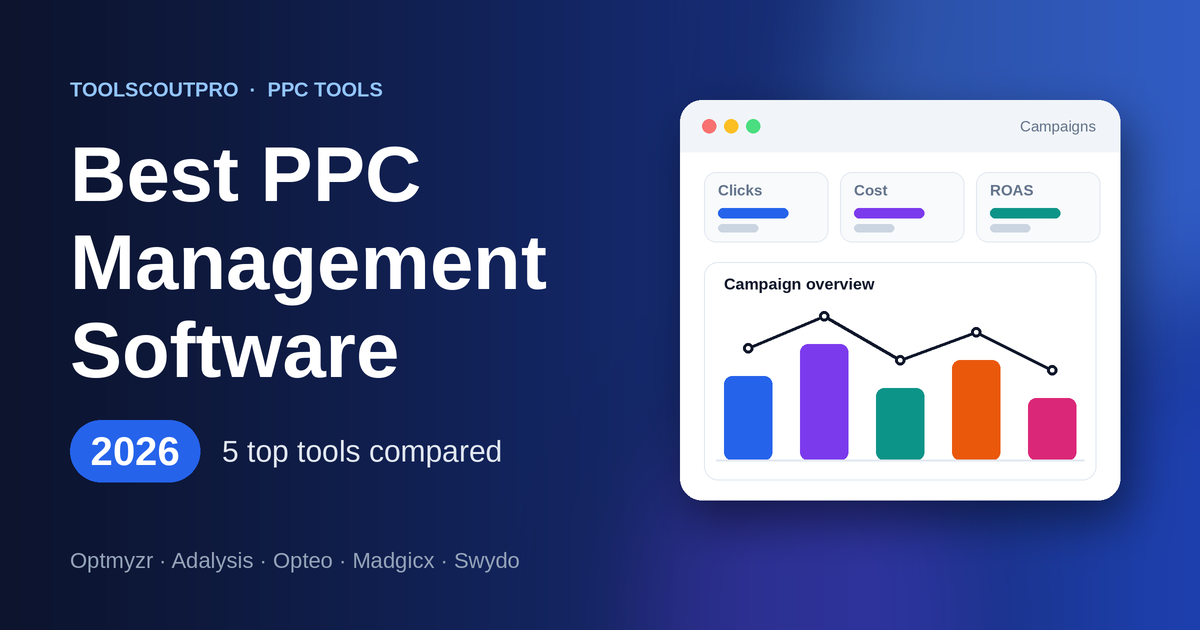
Optmyzr, Adalysis, Opteo, Madgicx and Swydo are the PPC management tools worth shortlisting in 2026, and the right pick depends on your ad platforms, monthly spend and whether you manage client accounts.
Quick picks
Pick Optmyzr for all-round agency work, Adalysis for ad testing, Opteo for Google-only teams, Madgicx for Meta ecommerce and Swydo for client reporting. Prices below are approximate monthly starting points from third-party listings as of October 2026; they vary by source, so confirm on each vendor’s site.
| Tool | Best for | Platforms | Starting price (USD/month) |
|---|---|---|---|
| Optmyzr | Agencies and in-house teams that want audits, rules and reporting | Google Ads, Microsoft Ads | About $208 to $299, rises with ad spend |
| Adalysis | Ad testing and account audits across many accounts | Google Ads, Microsoft Ads | About $126 to $149, rises with ad spend |
| Opteo | Google Ads specialists who want guided, one-click fixes | Google Ads only | $129 (Basic), up to $499 (Agency) |
| Madgicx | Ecommerce brands scaling Meta ads | Meta (Facebook, Instagram) only | About $44 to $55 at the lowest spend tier |
| Swydo | Agencies sending recurring client reports | Multi-platform reporting | About $62 to $69, rises per data source |
What PPC management software does
PPC management software sits on top of Google Ads, Microsoft Ads or Meta Ads and handles the repetitive work: spotting wasted spend, testing ad copy, adjusting bids and budgets, and turning data into client reports. It does not replace strategy, but it can save hours per account each week.
These tools fall into three groups:
- Optimization and audit tools (Optmyzr, Adalysis, Opteo) find issues and apply fixes.
- Platform automation tools (Madgicx) focus on one network and automate budgets, audiences and creative analysis.
- Reporting tools (Swydo) pull data from several platforms into scheduled client reports.

How these tools were chosen
Each tool was compared on four points: which ad platforms it supports, how its pricing scales, how much it automates versus recommends, and who it suits (agency, freelancer or in-house team). Pricing and feature notes come from vendor and third-party listings, linked in the Sources section. Some sources are published by competing vendors and are flagged there.
1. Optmyzr: best all-round tool for agencies
Optmyzr is the broadest option here, covering optimization suggestions, rule-based automation and customizable client reports for Google Ads and Microsoft Ads. Its reports can be exported as PDFs or slideshows with a custom logo, charts and metrics, which agencies use for client updates.
Pricing. Optmyzr prices by monthly ad spend. Listings put the entry Essentials plan at roughly $208 per month billed annually, or closer to $299 month to month, with a Premium plan above it and custom Enterprise pricing for spend over $500K. Annual billing is reported to save about 30%. There is a free trial but no free plan.
Pros
- Wide toolset in one platform: audits, rules, reporting and bulk changes
- Reporting suited to client work
- Spend-based tiers keep small accounts affordable
Cons
- Cost climbs as ad spend grows, and the live pricing page uses a spend slider rather than a fixed rate card
- More to learn than a lightweight tool; some reviewers call it premium-priced
Best for: agencies and in-house teams managing several Google and Microsoft Ads accounts.
2. Adalysis: best for ad testing and audits
Adalysis focuses on auditing Google Ads and Microsoft Ads accounts and on statistically driven ad testing. It also covers budget tracking, search term and keyword analysis, quality score analysis, reporting and a campaign builder that works from CSV files.
Pricing. Adalysis charges by maximum monthly ad spend, not by account or user. Listings show entry pricing of about $126 to $149 per month, depending on the source, with higher tiers up to $750K or more in monthly spend. One listing reports that every feature is included on every plan, with unlimited accounts and users. A free trial is offered, but there is no free plan, and trial length varies by source.
Pros
- Unlimited accounts and users makes it cost-effective for multi-account agencies
- Strong A/B ad testing with significance calculations
- Simple pricing logic: one variable, ad spend
Cons
- Covers Google and Microsoft Ads only
- Most fixes are recommendations a person reviews and applies, rather than fully autonomous changes
Best for: teams that want rigorous ad testing and regular account audits across many accounts.
3. Opteo: best for Google Ads specialists
Opteo monitors connected Google Ads accounts and surfaces prioritized recommendations that you can apply in one click. It covers more than 40 optimizations across keywords, ad tests, bids, exclusions and error detection, plus budget tracking, Slack alerts and branded client reports.
Pricing. Opteo publishes a clear rate card with account and spend caps:
| Plan | Price (USD/month) | Google Ads accounts | Monthly spend cap |
|---|---|---|---|
| Basic | $129 | 10 | $25,000 |
| Professional | $249 | 25 | $100,000 |
| Agency | $499 | 75 | $250,000 |
| Enterprise | Custom | Custom | Above $250,000 |
There is a 14-day free trial and no free plan.
Pros
- Transparent pricing and an easy, well-reviewed interface
- One-click apply keeps you inside the tool
- Good fit for boutique agencies and specialists
Cons
- Google Ads only; Microsoft Ads is not supported
- Spend and account caps can force an upgrade as you grow
- Some users note that parts of the information are also available inside Google Ads
Best for: freelancers and boutique agencies running Google Ads who want guided optimization.
4. Madgicx: best for Meta ecommerce advertisers
Madgicx is a Meta-only platform that combines automation, audience tools, creative analytics and attribution reporting. It also includes an AI ad generator that produces mostly static creatives and can launch them straight into Meta Ads Manager.
Pricing. Pricing is tiered by monthly Meta ad spend and shown inside the app. Listings report entry pricing of about $44 to $55 per month at the smallest spend bracket and about $129 per month in the $5K to $10K spend range. Spend above $30K per month requires a custom quote. An optional Cloud Tracking add-on is listed at $49 per month. There is a 7-day free trial and no permanent free plan.
Pros
- Deep Meta automation, rules and creative analytics in one place
- Attribution reporting helps with tracking gaps
- Fits established ecommerce brands spending $5K or more per month
Cons
- Meta only; it does not manage Google Ads
- Spend-tiered pricing is hard to compare before you sign up
- Some reviewers report weak customer support and campaigns that failed to activate
Best for: ecommerce brands that already spend consistently on Meta and want automation on top of Ads Manager.
5. Swydo: best for PPC client reporting
Swydo is a reporting and monitoring platform built for agencies. It pulls PPC, social and analytics data into scheduled client reports, and adds alerts and goal tracking, such as flagging a missed Google Ads ROAS target in Slack.
Pricing. Swydo bills by the number of data sources you connect, not by users or clients. Listings give a starting price of about $62 to $69 per month, with a free trial and no free plan. Annual billing carries a discount of about 10%.
Pros
- Low entry price for professional client reports
- Responsive support and quick setup, according to reviewers
- Unlimited reports, with monitoring and alerts included
Cons
- Per-data-source pricing can climb quickly across many clients and platforms
- No public API as of 2026
- It reports and monitors; it does not optimize campaigns
Best for: small and mid-sized agencies focused on paid media that need polished recurring reports.
More options worth a look
If the five tools above do not fit, these are cheaper or free routes to consider.
- Google Ads Editor is Google’s free desktop app for bulk edits and offline campaign building. It does not give recommendations or reporting, but it covers a lot of day-to-day management for small accounts.
- Adzooma is listed at about $69 per month for Google, Microsoft and Meta campaign management. This figure comes from a single listing, so verify it with the vendor.
- Platform-native recommendations inside Google Ads, Microsoft Ads and Meta Ads Manager are free, but they are written to favor spend, so treat them as a starting point rather than a verdict.
Which tool fits you
Start from the platforms you run, then compare the tools in each box using the reviews above.
How to choose PPC management software
Start with your ad platforms and spend, then check how pricing will behave as you grow.
- List your platforms. Google-only teams can use Opteo; Google plus Microsoft points to Optmyzr or Adalysis; Meta-only points to Madgicx.
- Check how pricing scales. Spend-tiered tools (Optmyzr, Adalysis, Madgicx) get dearer as budgets grow, while Opteo caps accounts and Swydo bills per data source.
- Decide between suggestions and automation. Some tools recommend and a human applies; others run rules automatically. Match this to how much oversight you want.
- Test reporting early. If you send client reports, build one during the trial and see how long it takes.
- Use the free trial on a real account. Most tools offer one and none offer a free plan, so test on live data before paying annually.
- Budget for add-ons. Tracking add-ons, extra data sources and higher spend tiers can raise the real monthly cost above the sticker price.
Frequently asked questions
What is the best PPC management software overall? Optmyzr is the strongest all-rounder for agencies working across Google and Microsoft Ads. Opteo suits Google-only specialists, and Madgicx suits Meta-focused ecommerce.
Is there a free PPC management tool? None of the five tools reviewed here has a free plan, though each has a free trial. Google Ads Editor is a free option for bulk edits.
Which tool is cheapest to start with? Madgicx and Swydo have the lowest listed entry prices, at roughly $44 to $69 per month, but their costs rise with spend or data sources. Adalysis and Opteo start near $126 to $129.
Do these tools replace an agency or specialist? No. They speed up audits, testing and reporting, but strategy, creative and judgment calls still need a person.
Why do prices differ between sources? Most vendors price by ad spend and show exact figures only in a slider or in-app, so third-party listings quote different entry points. Always confirm on the vendor’s own pricing page.